
On Art & The Algorithms
Popular art is good art, until it isn't.


For most of human history, the question of whether art was good was answered slowly, by discourse and disagreements over long periods of time. The disagreement itself was part of the process, the friction between a work and its resistant readers was what separated the durable from the merely admired. Nothing about this was clean or reliable; canons form badly, by exclusion and accident as much as by genuine discernment. But the inefficiency wasn’t purely ornamental. It meant that a work had to keep meaning something to people who had no stake in its success, that popularity and longevity were different measurements taken at different intervals. This is what kept the works alive, the ones we know today with the inference of “classics”. What the current moment has collapsed is that interval. A work is assessed in the first hours of its release, by the only instrument now sensitive enough to register mass response in real time, and that instrument was not built to measure what lasts, and to a greater threshold; what resonates.
Popularity has been a reliable measurement of agreement. When millions of people respond to the same work in roughly the same way, the accessibility is somewhat confirmed, its willingness to meet people where they are, to traffic in the familiar shapes of feeling rather than the unfamiliar ones, is validated without the need for an objective anchor. Despite how one may choose to interpret art, this framing is far from irrelevant. It tells us what a culture recognizes, what it finds comforting, what emotional motive it moves through most easily. However, it does not tell you whether the work will matter in twenty years, or whether it contains anything that resists being consumed in a single sitting and forgotten.
The confusion arises from democracy and the market simultaneously, for we have inherited the assumption that preference aggregates into judgment. If enough people say a thing is good, we take this as evidence that it is. But taste is not quantitative, and this is precisely where the algorithms fail. The question of whether a painting is significant is not answered by counting how many people bought prints of it. Quality in art has always been, in part, a function of what the work demands, of how much it requires the audience to bring, how much it withholds, how much remains after the first encounter has been metabolized. Popularity tends to minimize these demands as a structural necessity, or in more in a more relevant framing; as a mandate. The wider the intended audience, the more a work must sand away the individuality
Consider what individuality actually is in art: it is the presence of a sensibility that has not yet been normalized. Difficulty is not always evidence of depth, but the inverse is almost always true: work that has been designed to cause no difficulty has almost certainly eliminated something essential. The friction between a serious work and its audience is where meaning lives. Remove the friction, and what remains is the sensation of meaning, the emotional coloring without the substance.
Platforms that present themselves as havens for serious writing are no exception, and being ignorant of such conduct would be the dishonesty I do not stand for. They have, I must say, simply reshaped and covered it in a more appealing fabric. Substack’s recommendation system surfaces writing that generates rapid subscriber conversion and high open rates; what it functionally penalizes is work that leaves something unresolved, that asks the reader to sit with ambiguity rather than arrive at a shareable conclusion. A piece that opens a question and refuses to close it will underperform a piece that confirms what the reader already suspects, not because the audience is incapable of the former, but because the metric cannot distinguish between a work that provoked thought and one that simply failed to deliver. Interpretive space, the quality that separates an essay from an argument, a poem from a caption, reads, to the algorithm, as underperformance. So it gets buried, and what rises is writing that has learned to conclude with the satisfying firmness the system rewards.
This is the achievement of popular art at its most accomplished, and we don’t give it enough credit for the transition, for it produces the feeling of profundity without requiring any of the elements that made art resonate with the human race. A certain kind of film will swell the score at exactly the right moment, cut to a close-up of tears, and the audience will feel an emotional provocation. They will infer the film as effective, for it triggered a fairly appropriate response. But I would wager, the feeling was not earned by the work so much as triggered by it. Does aesthetic guarantee depth? If so, we might as well start considering the Instagram accounts that are purely driven to cultivate the aesthetic of the reader than the content and what reading actually stands for.
Dissatisfied with modern art, I may be, but dispossessed of heart, I shall never be. The ever widening gap between aesthetic central to art, and aesthetic as an integrated element for the art; dare I say, is the manipulation so practiced it has become invisible, and invisibility is what we call craft when we’re being kind and what we call cynicism when we’re being honest.
None of this is to say that popular art cannot be good, or that good art cannot become popular. Shakespeare was popular. So was Beethoven, eventually. Toni Morrison sold millions of copies. But in each of these cases, popularity followed or accompanied endless struggles, the work was not engineered for mass approval but arrived at it by other means, often posthumously, often after the culture caught up to what the artist had already understood. There is a difference between art that becomes beloved because it expanded what an audience could receive, and art that becomes beloved because it confirmed what the audience already believed about beauty, sadness, love, and justice. One leaves you altered, the other leaves you validated. And only one serves a utility beyond the aesthetic criterion we like to congratulate ourselves with.
Validation is what crowds are organized around. To be in a crowd responding to art is to have your response reflected and amplified by the people around you. This is intoxicating but not entirely dishonest, communal experience has its own reality, which is not devoid of meaning. But it is worth asking whether the work could survive outside that context, stripped of the shared energy of the stadium or the algorithm-curated playlist or the opening weekend. Much of what we call popular art is inseparable from the social conditions of its consumption. Alone, at a strange hour, with no one else to confirm your response, does the work hold?
Good art tends to hold. But how dare I classify art as “good” or “bad”? For It holds because it contains something that exceeds what you brought to it. It exposed you to a perspective you could not have known you needed to find. This is what Rilke meant when he wrote, of an archaic torso of Apollo, that you must change your life: the instruction arrives from the work, not from you, and it is not comfortable. Comfort is the enemy of this kind of encounter, for familiarity is efficient and mostly useless as a teacher. And popular art, whatever else it achieves, is almost always comfortable, or where uncomfortable, carefully controlled in its discomfort, it offers the catharsis that releases rather than the disturbance that lingers.
Our modern tastes are largely indifferent to my criticism. The most popular pieces of music are rarely, nowadays, crafted for cultivation. They are, rather, focused on the quickest hook and whether or not it would perform on the platforms that have turned music to an endless loop of consumption, to raise a generation that’s exposed to optimized content as the only mainstream adaptation of art. Art has slowly shifted from cultivation to exposure.
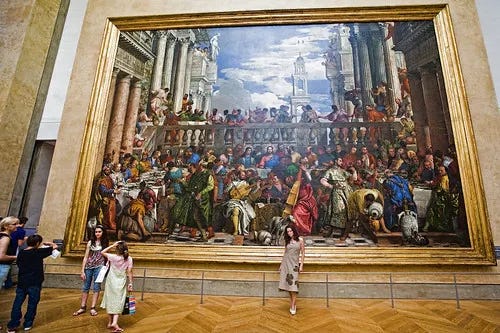
The painting given above, The Wedding Feast At Cana by Paolo Veronese, is a roommate to the endlessly photographed Mona Lisa, and yet; it remains lesser known.
I’m far from a communist, but capitalism has trained us to conflate attention with value, because that’s the only direct correlation between the non-tangible equity of art and the quantitative inferences. This is a confusion that serves the market well, for it renders attention quantifiable. A book can be ubiquitous before it has been read. Because the system ensures the art and the artist remain conflated in the public perception. The noise around a work is far from neutral in the modern day and age, it shapes how the work is received, what questions get asked of it, whether it is encountered as an event or as an object. Good art, encountered as an event, often reads as overwhelming. Encountered as an object, it can be assessed on its own terms. Popular art is almost always an event, it requires the noise to sustain it, and the noise is part of what gets mistaken for quality. Needless to say, this is precisely why the modern exegesis of art is more about marketing than the craft.
The harder admission is that we are not reliable readers of our own responses. The feeling of a certain emotion evoked by exposure isn’t insignificant, but it does not distinguish between what moved us and what triggered us. Most of us have cried at films we know are manipulative and sat unmoved through films we know are great. Our emotional responses are far from a clean index of value, a record of our histories would perhaps he closer to the truth, they are testaments to our formations, our most accessible wounds. Art that knows where those wounds are and presses on them with precision will always feel powerful. With the help of a subtle analogy, we could frame a question of whether it found those wounds by honestly exploring something, or whether it mapped them the way a market researcher maps a demographic.
What separates the two is not that one is sincere and the other cynical, plenty of calculated work is inspired and backed by expression and plenty of sincere work is made without considerable thought. The more precise distinction is between work that was altered by its own making and work that arrived at completion without having been surprised. A painting that changed what the painter understood about what he was painting carries that change inside it as a structural irregularity no permutation or algorithm can imitate, it’s a mark where the form bent under pressure that wasn’t aesthetic, and yet it served the viewer an aesthetic experience, for it leaves room for interpretation. The work beats the mark of creation and the mark of individuality, without that, it’s nothing more than content that just so happens to possess all for formal properties of art.
And yet, for all this, I refuse to be optimized.
Not everything that matters can be surfaced, nor persuaded into immediacy.
And if my voice must fail, let it fail unaltered.
I really enjoyed your article, but what spoke to me was specifically the line about “work that was altered by its own making”. Because to me, that is really the distinction that matters. Not sincerity versus cynicism. But whether the thing being made changed the person making it.
Your essay made me think about conscious ownership the same way I think about serious art. Both require you to bring something. Both leave you altered if they're working. And both get buried by systems optimized for the frictionless response.
I agree with you - I refuse to be optimized either.
I sat with this post for days; the depth demanded tithe.
I agree that, by design, contemporary platform algorithms incentivize consumption of a distilled product over the ideal of *art as process*, we can state this without making qualitative judgements about either, but I am not convinced that this is completely new.
The technology is new; I see with you how the "...current moment has collapsed [the time] interval," but I also see these algorithms as the latest (and scariest) iteration in the long history of narrative and power.
When I look to history, I don't see the durability of art so much as the pattern of durability in institutions. Modern algorithm wars mirror so many intense political and theological battles of the past, which directly influenced patronage of monumental art. I have a great appreciation of the satirical genius that Michelangelo was.
For me personally, interaction in these spaces is a constant test of agency. Sometimes friction feels like waste rather than process. That's a relationship with time problem for me, not a problem with technology.
I appreciated your post, and your beautiful writing. It led me down many interesting rabbit holes and gave me an idea for a new story about an artisan glass blower. I also wrote a depressing poem about dead birds but that one will stay off the algorithm.